
14-Step Night Hair Care Routine for Healthier Hair

A good night hair care routine does more for your hair than most people expect, since seven or eight hours of tossing, turning, and friction against a pillow can undo a lot of the care you put in during the day.
The good news is that a real nighttime routine takes only a few minutes and mostly comes down to protecting what you already have rather than adding anything complicated. Below are fourteen steps you can build into your own night hair care routine, so you wake up to hair that actually looks like it rested too.
1. Brush and Detangle Before Bed
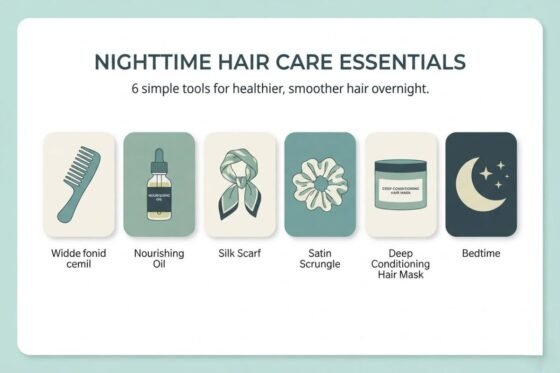
Brushing hair out completely before bed distributes natural oils from your scalp down the length of each strand, which helps hair look less dry by morning without adding a single product.
Use a wide-tooth comb or a brush designed for detangling rather than a fine-tooth comb, since fine teeth tend to snag and break hair that is already a little tired from the day.
2. Apply a Leave-In Conditioner or Hair Oil
Work a small amount of leave-in conditioner or a lightweight oil through the ends of your hair after brushing, focusing on the driest sections rather than the scalp.
A little goes further than you would think, since too much product overnight can leave hair looking greasy rather than nourished by morning. Argan, jojoba, and grapeseed oils all work well for this step.
💡 Quick Tip
Warm the oil slightly between your palms before applying, since it spreads more evenly through the ends that way.
3. Switch to a Silk or Satin Pillowcase
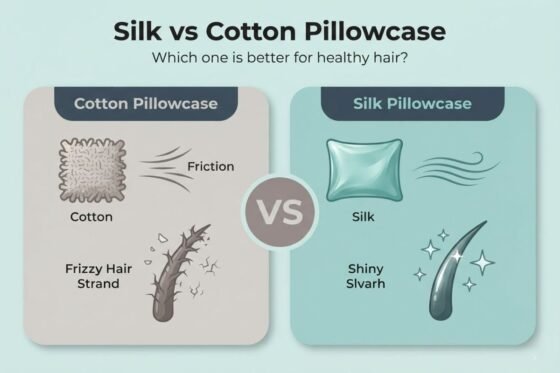
People often assume a pillowcase is just a pillowcase, but cotton actually creates real friction against hair overnight, which leads to extra tangles, breakage, and frizz that shows up the next morning.
Silk or satin lets hair glide rather than catch, and it is one of the lowest effort changes on this entire list. A satin bonnet works just as well if you prefer that option.
More friction, more overnight tangling and breakage.
Less friction, hair glides rather than catches.
4. Loosely Braid or Twist Your Hair
Keep any nighttime braid or twist loose rather than tight, since tension held overnight for hours can lead to breakage right at the root over time.
One or two large braids work better than several small tight ones for most hair types, and they also tend to leave a soft, natural wave once you take them out in the morning.
Getting the braid right
5. Wrap Hair in a Silk Scarf or Bonnet
Gathering hair into a loose bun and wrapping it in a silk scarf or bonnet protects the entire head from pillow friction at once, rather than relying on the pillowcase alone.
This step matters most for curly, coily, or chemically treated hair, since those textures tend to lose moisture and definition fastest overnight without some kind of covering.
6. Massage Your Scalp for a Few Minutes
Spend two or three minutes working small circles across your scalp with your fingertips before bed, moving from the hairline back toward the crown.
This simple habit may help support blood flow to the follicles, and it doubles as a genuinely relaxing way to wind down before sleep. Add a few drops of a lightweight oil if your scalp tends to run dry.
Work small circles across the scalp with fingertips.
Move from the hairline back toward the crown.
Add a few drops of oil if the scalp runs dry.
7. Avoid Tight Hairstyles Before Bed
A tight ponytail or bun worn straight through the night pulls steadily on the same section of hair for hours, which over time can contribute to a specific kind of thinning at the hairline.
Loosen your usual style before bed, or switch to a loose braid instead. This is one of the more reversible habits to fix if you catch it early.
Loosen ponytails and buns before bed.
Switch to a loose braid overnight instead.
Sleeping in the same tight style every night.
Ignoring tension right at the hairline.
8. Use a Hair Mask on Wash Nights
Apply a deep conditioning mask on the nights you wash your hair, leaving it in for the time listed on the product rather than rinsing it out early to save time.
Focus the mask on the mid-shaft to ends, where hair tends to be driest, rather than the scalp. This step works especially well once or twice a week rather than every single wash.
| Detail | Note |
|---|---|
| Frequency | Once or twice a week, not every wash. |
| Focus area | Mid-shaft to ends, skip the scalp. |
9. Keep Heat Styling Products Away From Bedtime
Avoid heat styling right before bed specifically, since hair needs a little time to cool and set before it gets compressed against a pillow all night.
If you do use heat earlier in the evening, apply a heat protectant beforehand regardless of the time of day, and let hair cool completely before lying down.
Let heat-styled hair cool completely before it gets compressed against a pillow.
10. Pineapple Method for Curly Hair
Gather curls loosely at the very top of your head into a high, loose ponytail, nicknamed the pineapple, to keep curls from getting crushed flat against the pillow overnight.
Use a soft scrunchie rather than a tight elastic, since a tight tie at the base can create a dent or crease in the curl pattern by morning.
- ▸Gather curls high on the crown, loosely.
- ▸Use a soft scrunchie, not a tight elastic.
- ▸Keeps curls from crushing flat overnight.
11. Apply an Overnight Repair Serum
A dedicated overnight serum, applied to the ends after your regular leave-in, gives ingredients like peptides or ceramides several uninterrupted hours to actually absorb into the hair shaft.
This step is optional rather than essential, but it suits anyone dealing with chemically treated, heat-damaged, or color-treated hair that needs extra repair time. It suits two or three nights a week rather than every night.
12. Protect Your Hairline with a Silk Edge Wrap
A thin silk wrap tied gently around the hairline specifically, rather than the whole head, helps keep edges smooth and laid overnight without the tension of a tight scarf.
Keep the wrap snug but not tight, since edges are some of the most fragile hair on the whole head and respond poorly to constant pulling.
📌 Good To Know
Edges respond poorly to constant tension, so snug is the goal here, not tight.
13. Keep a Consistent Wash-Day Schedule
Washing hair on a predictable schedule, rather than reactively whenever it feels dirty, lets your nighttime routine actually work with your hair’s natural rhythm instead of against it.
Most hair types do well with washing every two to three days, though this varies based on how oily or dry your scalp tends to run.
Inconsistent, works against a nighttime routine.
Works with your hair’s natural rhythm.
14. Morning Refresh Routine
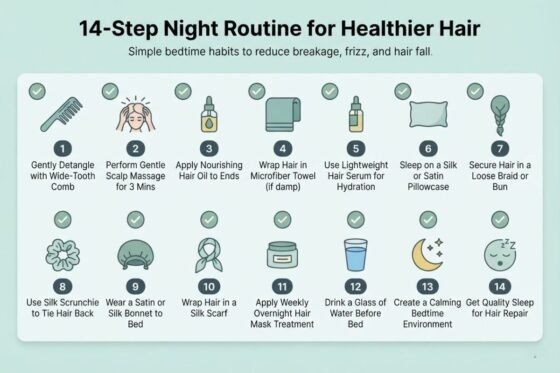
Unwrap or unbraid hair gently in the morning rather than pulling quickly, since hair is still a little more fragile right after sleep than it is later in the day.
A quick spritz of water or a light refreshing spray, followed by finger styling rather than a full brush-out, usually brings curls or waves back to life without undoing the work from the night before.
Waking up gently
Final Thoughts
A night hair care routine does not need to be elaborate to actually work. Brushing hair out, switching to a silk pillowcase, and keeping any overnight style loose cover most of what hair actually needs to recover from the day.
Add in a mask or overnight serum on the nights that call for it, and give the whole routine a couple of weeks before judging results, since overnight care tends to show up gradually rather than all at once. For more ways to protect strands day to day, our guide on getting rid of split ends covers the daytime half of the equation.
Frequently Asked Questions
How long should a night hair care routine take?
Most of the steps above take five to ten minutes total once they become a habit, since brushing, applying product, and wrapping or braiding hair are all quick once you have a routine down.
Do I need a silk pillowcase and a bonnet, or just one?
Either one significantly reduces friction on its own, so choose whichever you are more likely to actually use consistently rather than trying to manage both every single night.
Is it bad to go to sleep with wet hair?
Sleeping with fully wet hair can leave it more prone to tangling and, in some cases, scalp issues from prolonged dampness, so it is generally better to let hair air dry at least partway before bed.
Can a night routine help with hair growth?
A night routine mainly protects the length you already have from breakage rather than directly speeding up growth, though less breakage often makes hair look like it is growing faster since less length is lost.