13 Untamed Leopard Print Hair Ideas (Bold, High-Fashion & Surprisingly Low-Drama)

Stepping away from safe balayage into full leopard print takes actual nerve, and if you’re sitting with that mix of excitement and low-key panic about your hair right now, that’s a completely normal place to be.
Leopard print consultations tend to follow a pattern I could set my watch to, pure excitement followed almost immediately by the same worry: what if my hair snaps before the pattern even goes on, or what if it just looks like a costume instead of a statement.
These 13 ideas are built to give you real leopard energy while actually protecting your strands through the process.
The 3 Wild Rules of Animal Print Hair
Canvas Matters
A buzz cut, blunt bangs, or a clean undercut show off rosette spots the way a gallery wall shows off art, flat and unobstructed. Loose curls or heavy shrinkage can blur those same spots into a fuzzy blob instead of a crisp pattern, so the shorter and sleeker your canvas, the more your leopard print actually reads as leopard print instead of just messy color.
Lifting Is Mandatory
If you’re starting from a dark base, leopard spots need real contrast to show up clean, which usually means lifting your whole head to a pale yellow level 8 or higher before any pattern goes on. That’s a genuine chemical process, not a quick gloss, so bond protection during every session matters more here than with almost any other color trend. If your hair already feels fragile heading into this, a scalp and strand-repairing mask the week before your first lift session gives your hair a stronger starting point.
The Maintenance Gameplan
Once the base and spots are both in, deposit-only glosses keep everything vibrant without lifting your hair any further, and a small detail brush lets your colorist touch up individual spots as your roots grow out instead of redoing your whole head. This is the difference between leopard print that looks intentional for months and leopard print that turns into a blurry mess after four weeks. If daily wear on already-processed hair has you worried, our guide on growing hair thicker naturally has real fixes worth folding into your routine.
Now for the fun part: thirteen leopard print ideas sorted by how bold you’re ready to go, from full-head statements to small, low-commitment placements. If full leopard feels like a bigger leap than you’re ready for, our dark brown balayage guide has softer, more dimensional ideas that still feel fashion-forward.
Group 1: Full-Volume Statements
These four are for the days you want zero doubt about your commitment to the look. Full coverage, full drama, full confidence.
1. Classic Amber & Black Buzz Cut
On a buzz cut, every single spot sits in full view with nowhere to hide, which is exactly what makes this the cleanest, most graphic version of leopard print you can get. Warm amber and deep black read as high-fashion editorial rather than costume, especially against warm or olive skin tones.
Maintenance: High | Salon Visit: Every 4-5 weeks for spot refresh | Best For: Any starting base level, bold and confident energy
- Creative Care Hack: Use a sulfate-free, color-safe shampoo and skip daily washing, buzzed hair actually shows fading faster since there’s no length to hide it.
- Who Should Skip This: Anyone not ready to commit to short hair for the next several months, this style needs the buzz to work.
💬 Tell your colorist: “I want a level 8 amber gold base with deep black rosette spots, evenly spaced across the whole head.”
2. Platinum Base with Charcoal Rosettes
A near-white platinum base makes charcoal gray rosettes look almost sculptural, like the pattern was carved into the hair rather than colored onto it. It’s softer than jet black spots, which makes it a little more wearable for daily life while still being unmistakably leopard.
Maintenance: Very High | Salon Visit: Toner every 3-4 weeks, spot refresh every 5-6 weeks | Best For: Level 9-10 platinum base, cool or neutral undertones
- Creative Care Hack: A purple toning shampoo once a week keeps the platinum base from pulling yellow between salon visits.
- Who Should Skip This: Anyone with previous chemical damage from color or relaxers, platinum lift is one of the most demanding processes on this list.
💬 Tell your colorist: “Lift me to a clean platinum level 9-10 base first, then place charcoal gray rosettes, not black.”
3. Neon Lime Slime Leopard Buzz
Neon lime as a base color turns leopard print into something completely fantasy and fun instead of naturalistic, and on a buzz cut it practically glows under any kind of stage or event lighting. It reads as art before it reads as hair, which is exactly the point.
Maintenance: Very High | Salon Visit: Every 3-4 weeks, neon fades fastest of any color family | Best For: Level 9-10 base, maximalist and fearless energy
- Creative Care Hack: A color-depositing conditioner in a matching neon shade noticeably extends the vibrancy between full color sessions.
- Who Should Skip This: Anyone in a workplace with a conservative dress code, this one is genuinely as bold as hair color gets.
💬 Tell your colorist: “Full lift to a pale yellow base, then a neon lime green all over with black rosette spots layered on top.”
4. Icy Blue Base with Navy Spots
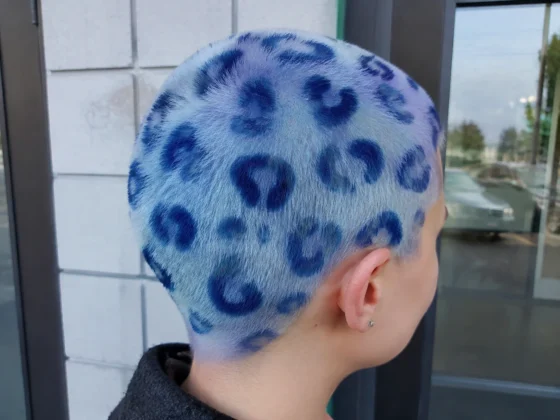
A pale icy blue base with deep navy spots gives leopard print a cooler, almost wintry feeling that still reads unmistakably as the pattern. It’s a favorite for cooler skin tones, since the blue undertone genuinely flatters rather than fighting against your complexion.
Maintenance: High | Salon Visit: Every 4-5 weeks | Best For: Level 9-10 base, cool undertones, dramatic but not neon energy
- Creative Care Hack: Cold water rinses slow blue fade significantly compared to washing in warm or hot water.
- Who Should Skip This: Warm, golden undertones, the icy blue base can wash out warmer complexions instead of complementing them.
💬 Tell your colorist: “Lift to a pale base, tone icy blue, then place navy spots for contrast that isn’t pure black.”
Group 2: Dimensional & Low-Commitment Placements
Not ready for a full head of leopard? These four give you real pattern with a fraction of the lift, damage, and daily maintenance. A money piece or face-framing placement pairs especially well with a short cut, so if you’re short on length already, our short dark hair color ideas guide has more placement inspiration to pull from.
5. Peekaboo Nape Panel
A small panel of leopard spots hidden underneath your natural length at the nape means the pattern only shows when you want it to, whether that’s a low bun or hair tucked behind your ears. It’s the lowest-commitment way to actually try this trend before going bigger.
Maintenance: Low-Medium | Salon Visit: Base touch-up only every 8-10 weeks | Best For: Any base level, curious first-timers
- Creative Care Hack: Keep the panel styled forward most days so it stays protected from sun fading, and flip it out when you actually want it seen.
- Who Should Skip This: Anyone who wants leopard print visible in every single photo, this placement is genuinely meant to be hidden most of the time.
💬 Tell your colorist: “Section out just a small panel underneath at the nape, lift only that section, then place spots there.”
6. Money Piece Leopard Face-Frame
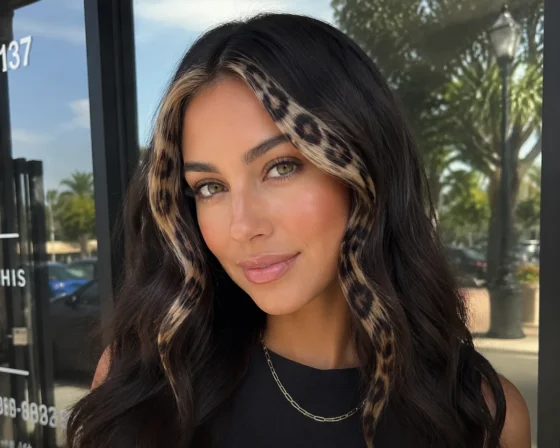
Leopard spots placed only on the face-framing pieces around your money piece catch the light every time you move, drawing attention straight to your eyes and cheekbones without touching the rest of your hair. It reads as intentional, high-fashion detail rather than an all-over commitment.
Maintenance: Low-Medium | Salon Visit: Every 6-8 weeks | Best For: Any base level, subtle but editorial energy
- Creative Care Hack: A lightweight leave-in on just those face-framing pieces keeps them from looking dry and brassy faster than the rest of your hair.
- Who Should Skip This: Very short hair without enough length to properly frame the face, this placement needs a few inches to work.
💬 Tell your colorist: “Lift and place spots only on my face-framing pieces around the money piece, leave the rest of my base color untouched.”
7. Side-Shaved Temple Leopard Accent
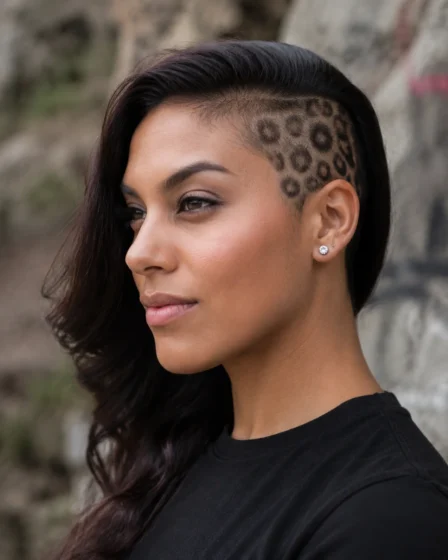
A small shaved or closely clipped panel at one temple gives you a graphic, almost tattoo-like leopard accent that reads bold in photos but is genuinely easy to grow out whenever you’re ready for a change. It pairs beautifully with an otherwise completely natural color everywhere else.
Maintenance: Low-Medium | Salon Visit: Every 4-6 weeks for the shaved section only | Best For: Any base level, edgy but low-commitment energy
- Creative Care Hack: Use clippers with a guard at home to maintain the shaved section between full salon visits.
- Who Should Skip This: Workplaces or schools with strict grooming policies around shaved sections, check first before committing.
💬 Tell your colorist: “Shave or clip just this one temple panel, then place spots directly on the shortest section only.”
8. Leopard Spots on Sleek Bangs
Placing the pattern only across a set of sleek, blunt bangs gives you leopard print exactly where people look first, your forehead and eyes, without a single spot anywhere else on your head. It’s graphic, unexpected, and surprisingly wearable for daily life.
Maintenance: Low-Medium | Salon Visit: Every 6-8 weeks | Best For: Any base level, blunt or straight-across bang shape works best
- Creative Care Hack: Flat iron the bangs before styling, the spots read cleaner and more defined on smooth, flat hair than on textured strands.
- Who Should Skip This: Curly or very textured bangs, the pattern distorts more easily without a sleek, flat finish.
💬 Tell your colorist: “Lift and place spots only across my bangs, keep the rest of my base color exactly as it is now.”
Group 3: Creative Color Fusions
For anyone who wants leopard print blended into something even more personal, these three fuse the pattern with a completely different color story. If creative color exploration is already your thing, our colored curly hair ideas guide has more inspiration in that same spirit.
9. Dusty Rose Gold Leopard Blend
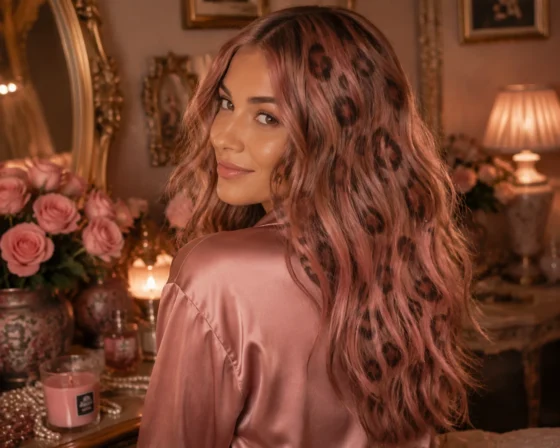
A soft, dusty rose gold base gives leopard print a romantic, almost vintage feeling instead of a harsh, graphic one, with warm black spots blended in rather than sitting in stark contrast. It flatters warm and neutral skin tones especially well.
Maintenance: High | Salon Visit: Toner every 4 weeks, full refresh every 8 weeks | Best For: Level 8-9 base, warm undertones, romantic maximalist energy
- Creative Care Hack: A rose gold color-depositing conditioner between salon visits keeps the base from fading into plain blonde too quickly.
- Who Should Skip This: Cool, pink undertones, the warmth in rose gold can clash rather than flatter here.
💬 Tell your colorist: “Lift to a level 8-9 base, tone a soft dusty rose gold, then blend in warm black rosette spots, not stark ones.”
10. Sunset Gradient Base with Black Spots
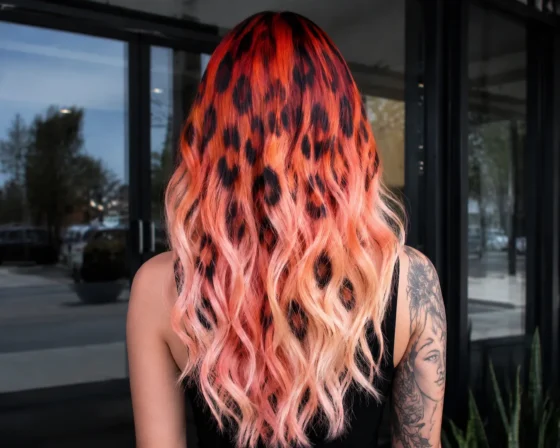
A gradient base moving from warm orange at the roots into a softer peachy blonde at the ends gives this leopard print genuine movement and depth, like the pattern is catching actual sunset light. Black spots placed mostly through the mid-lengths and ends make the gradient the real star while the leopard adds texture on top.
Maintenance: Very High | Salon Visit: Every 4-5 weeks, gradient and spots both need refreshing | Best For: Level 9 base, warm undertones, bold and artistic energy
- Creative Care Hack: Heat protectant before any styling is non-negotiable here, this base involves some of the most processed hair on the entire list.
- Who Should Skip This: Anyone not ready for a genuinely intensive maintenance routine, this is the most demanding idea in this whole post.
💬 Tell your colorist: “Create a warm orange to peachy blonde gradient from root to end, then place black spots through the mid-lengths and ends.”
11. Half-and-Half Split Dye with Leopard Side
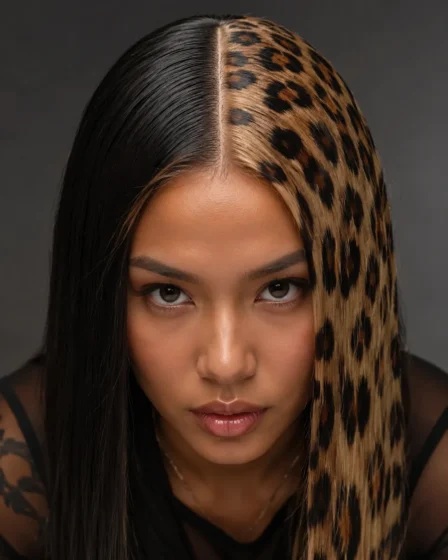
One half of your head stays your natural or current color while the other half goes full leopard, creating a bold visual split that reads as fashion statement rather than accident. It’s dramatic without requiring your entire head to go through the lifting process.
Maintenance: High | Salon Visit: Every 5-6 weeks for the leopard side | Best For: Any base level on the natural side, dramatic and artistic energy
- Creative Care Hack: A deep part rather than a middle part makes the split feel more intentional and less like a symmetrical accident.
- Who Should Skip This: Anyone wanting a subtle, everyday look, a half-and-half split is genuinely meant to turn heads.
💬 Tell your colorist: “Keep this half of my head completely natural, lift and place leopard spots only on the other half.”
Group 4: Graphic & Pattern Precision
These last two are for the true pattern purists who want the spots themselves to be the entire point.
12. Two-Tone Rosette Leopard Pattern
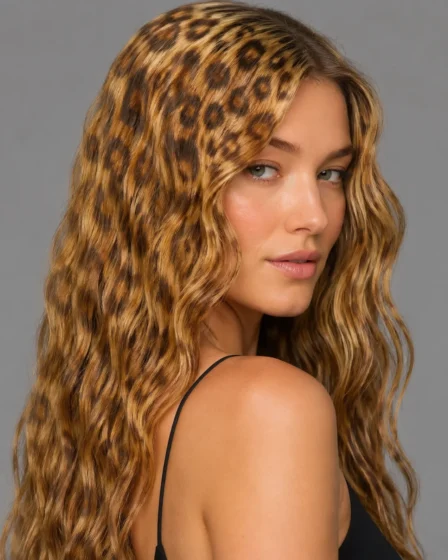
True rosette spots, meaning a ring of darker color around a lighter center rather than a single solid dot, are the most technically demanding and most authentic-looking version of leopard print you can get. It’s the closest hair color comes to actually replicating real leopard fur.
Maintenance: Very High | Salon Visit: Every 4 weeks, rosettes need the most detailed touch-up work | Best For: Level 9-10 base, patient and detail-oriented energy
- Creative Care Hack: Ask your colorist to photograph the pattern from multiple angles at your first appointment, it makes touch-ups far more accurate later.
- Who Should Skip This: Anyone who values low-maintenance color above almost everything else, true rosettes are a genuine commitment.
💬 Tell your colorist: “I want true two-tone rosettes, a ring of darker brown around a lighter gold center, not solid black dots.”
13. Sleek French Bob with Leopard Fringe & Ends
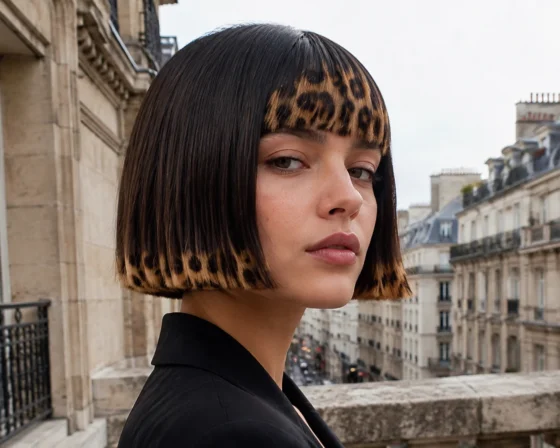
A clean, blunt French bob keeps most of your color simple and wearable, while leopard print concentrated only on the fringe and the very ends adds graphic detail exactly where it photographs best. It’s polished and editorial rather than chaotic, since the pattern has a clear, contained boundary.
Maintenance: Medium-High | Salon Visit: Every 6 weeks to maintain both the blunt shape and the spot placement | Best For: Level 8-9 base on the placement areas, chic and editorial energy
- Creative Care Hack: A flat iron before styling keeps both the bob shape and the leopard fringe reading crisp and intentional.
- Who Should Skip This: Hair that doesn’t hold a blunt shape well, waves or curls blur the clean lines this style depends on.
💬 Tell your colorist: “Keep the bob and most of my base color simple, place leopard spots only across my fringe and the very ends.”
Quick Comparison: All 13 Ideas at a Glance
| Idea | Maintenance | Salon Visit | Best For |
|---|---|---|---|
| Classic Amber & Black Buzz Cut | High | Every 4-5 weeks | Any base, bold energy |
| Platinum Base, Charcoal Rosettes | Very High | Toner 3-4 wks, spots 5-6 wks | Level 9-10 base |
| Neon Lime Slime Leopard Buzz | Very High | Every 3-4 weeks | Level 9-10 base |
| Icy Blue Base with Navy Spots | High | Every 4-5 weeks | Level 9-10 base, cool tones |
| Peekaboo Nape Panel | Low-Medium | Every 8-10 weeks | Any base, first-timers |
| Money Piece Leopard Face-Frame | Low-Medium | Every 6-8 weeks | Any base |
| Side-Shaved Temple Accent | Low-Medium | Every 4-6 weeks | Any base |
| Leopard Spots on Sleek Bangs | Low-Medium | Every 6-8 weeks | Any base, blunt bangs |
| Dusty Rose Gold Leopard Blend | High | Toner 4 wks, refresh 8 wks | Level 8-9, warm tones |
| Sunset Gradient, Black Spots | Very High | Every 4-5 weeks | Level 9, warm tones |
| Half-and-Half Split Dye | High | Every 5-6 weeks | Any base, dramatic energy |
| Two-Tone Rosette Pattern | Very High | Every 4 weeks | Level 9-10 base |
| Sleek French Bob, Leopard Fringe | Medium-High | Every 6 weeks | Level 8-9 base |
Leopard Print Hair FAQ
❓ Do I need to bleach my hair for leopard print spots to show up?
If you’re starting from a dark base, yes, some lifting is needed so the spots have enough contrast to actually read as a pattern instead of blending in. If your hair is already light or blonde, you may need far less lift, or in some cases none at all, depending on how dramatic you want the contrast to be.
❓ Can I get a leopard print look on dark hair without severe damage?
Placement-based ideas like the Peekaboo Nape Panel, the Side-Shaved Temple Accent, or spots on just your bangs limit how much hair actually needs to be lifted, which limits the damage too. Spreading the lift across a couple of sessions instead of one aggressive appointment, with bond protectant every time, also makes a real difference.
❓ What is the lowest-maintenance leopard print hair placement?
The Peekaboo Nape Panel wins here easily, since it’s small, mostly hidden, and only needs an occasional base touch-up rather than constant spot refreshing across your whole head.
❓ How do I maintain the shape of the spots as my hair grows out?
Ask your colorist about a detail brush touch-up at the root line every few weeks rather than waiting for a full regrowth before fixing it. Smaller, more frequent touch-ups keep the pattern crisp, while letting it grow out completely between visits is what causes the spots to look distorted or melted.
Choosing a hair color this bold is its own kind of self-expression, and there’s real courage in wanting your hair to actually look like you feel on the inside. Whatever placement or palette you land on, you get to define what wild means for you, not the other way around.
Which wild statement are you leaning toward, the Classic Amber Buzz Cut or the Subtle Peekaboo Panel?